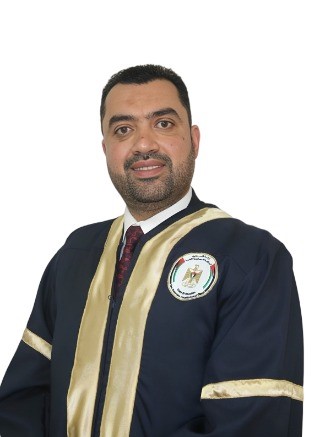
H.E. Justice Dr. Abdelnasser Abu Samhadana
Justice Dr. Abdelnasser Abdullah Abu Samhadana obtained his PhD in Public Law and Litigation from Ain Shams University in 2009, and he earned his Master's Degree in Law from the same University. He obtained his licence (Bachelor) Degree in Law and Police Sciences in 1999 from the Egyptian Police Academy.
In terms of legal and practical experience, he served as a Prosecutor from 1999 to 2005, and then he became the Director of the Public Prosecutions until he joined the Panel of the Supreme Constitutional Court.
He participated in numerous seminars and conferences related to the Public Prosecution since his appointment until he moved to the Supreme Constitutional Court. He also engaged in pleading before various Palestinian courts. He was one of the founding members of the International Union of Arab Lawyers and Jurists.
Furthermore, he was accredited as an arbitrator at Ain Shams Rights Arbitration Center and served as the Deputy President of the Palestinian Association for Criminal Sciences. Additionally, he held the position of the Director of the Legal Journal of the Public Prosecution and served as a member of the arbitration tribunals for several journals.
Dr. Abu Samhadana successfully completed several training courses in various legal subjects and participated in multiple training sessions, where he served as an accredited trainer and assessor at the Palestinian Judicial Institute. He was also a member of several preparatory committees for conferences of the Public Prosecutions and was a member of the Arab Organization for Constitutional Law.
Moreover, he supervised and examined several Master's theses related to legal fields. Additionally, he serves as a judge in the Administrative Court at the League of Arab States. Furthermore, he previously held the position of the Secretary of the Academic Committee at the Palestinian Judicial Institute.
Dr. Abu Samhadana has numerous scientific publications, including a collection of books, articles, and peer-reviewed research papers published in local, Arab, and international journals, Moreover, he has participated as a speaker in numerous conferences, seminars, workshops, and meetings on legal issues at the local, Arab, and international levels. He has also provided several commentaries on Palestinian arbitration provisions.
Furthermore, he has academically supervised the staff of the Public Prosecution in the Administrative Staff Diploma Program at Birzeit University. Dr. Abu Samhadana was also part of the International Visitor Leadership Program in the United States in 2018.