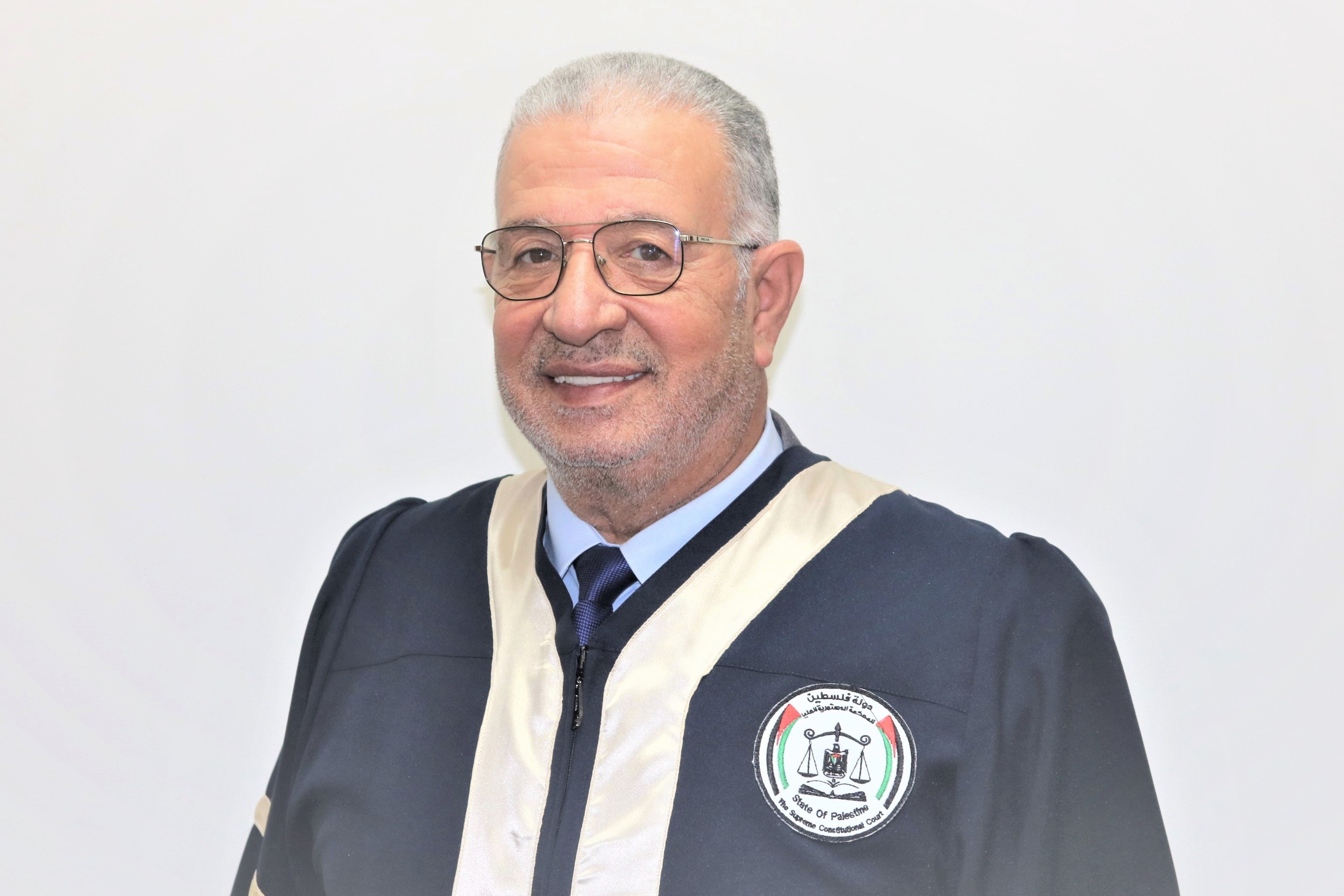
Speech of the President of the Supreme Constitutional Court
Justice Ali Muhanna
Some may assume that as Palestinians, we adopt the uniqueness of our experience as an excuse for our shortcomings and passion for breaking the rules and expanding exceptions, thus evading accountability. However, those who have lived and immersed themselves in this experience know that it is actually an exceptional case to be acknowledged and not standardized and it does not fit into ready-made models or standard templates, as its building blocks were formed with individuality and distinctiveness, just as in the stumbling blocks of its rugged journey.
The uniqueness of the experience is not limited to the political aspect and what is known as the struggle for liberation which is yet to be fully accomplished. It goes beyond that to encompass the ramifications of the nation-building battle with all its different extensions and dimensions, including the pillars of the justice sector, leading up to the establishment of the Supreme Constitutional Court and the constitutional oversight of the various forms of legislations.
As it is known, there is no Constitution in Palestine, and our Basic Law was primarily designed to regulate the transitional phase, which was supposed to last no more than five years from the establishment of the National Authority. It stated in its preamble that it includes a number of constitutional principles, but it did not cover all the aspects comprehensively. Therefore, it is unable to respond to the needs of the developments that have occurred in the Palestinian experience, both in reality and legally, over the past two decades.
In the same context, there has been a debate about the possibility of early constitution-making for the State of Palestine, given the ongoing occupation on one hand and the majority of the Palestinian people living in exile and diaspora on the other. Amidst these complexities, the enactment of Law No. 3 of 2006 of the Supreme Constitutional Court was a prelude to its formation and a response to the Provisions stated in the Palestinian Basic Law of 2003 and its amendments.
Based on that, the first formation of the Court took place on March 31, 2016, and it assumed its responsibilities pursuant to the Law. The second formation of the court was completed on June 1, 2023, after the remaining justices from the first formation of the Court were referred to retirement pursuant to the provisions of the Law. Hence, the second formation was completed by appointing the final group of justices and the second President of the Court.
During the past years, the Law of the Court has been amended multiple times, the most significant of which was the amendment of 2017 Over the years of its work, the Court has laid the initial foundations for its esteemed institution, and we seek Gods assistance and guidance in further consolidation of the principles of the supremacy of constitutional rules, the rule of law, judicial independence, and the integrated separation of the three powers.
On this occasion, we are aware that our journey is challenging, and we need to be open to learning from others and benefit from the rich regional and international experiences, while also considering the uniqueness of our reality and experience. The ultimate goal is to serve the interests and legitimate rights of the Palestinian people, placing them at the forefront of our endeavors.